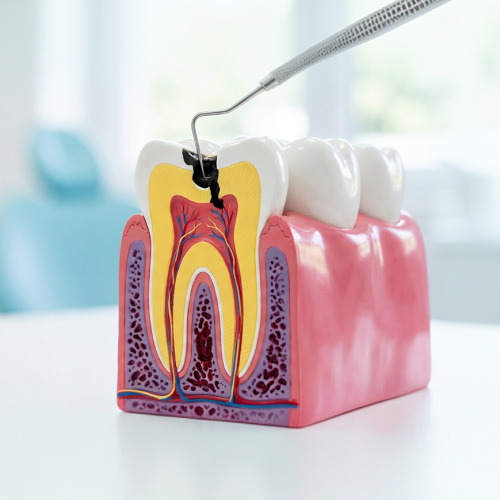
Root Canal Recovery, Pain, and What to Expect at Every Stage
Wondering what root canal recovery is really like? Learn what to expect, manage discomfort, and ensure quick healing. Book your consultation in Riverside today!
Read More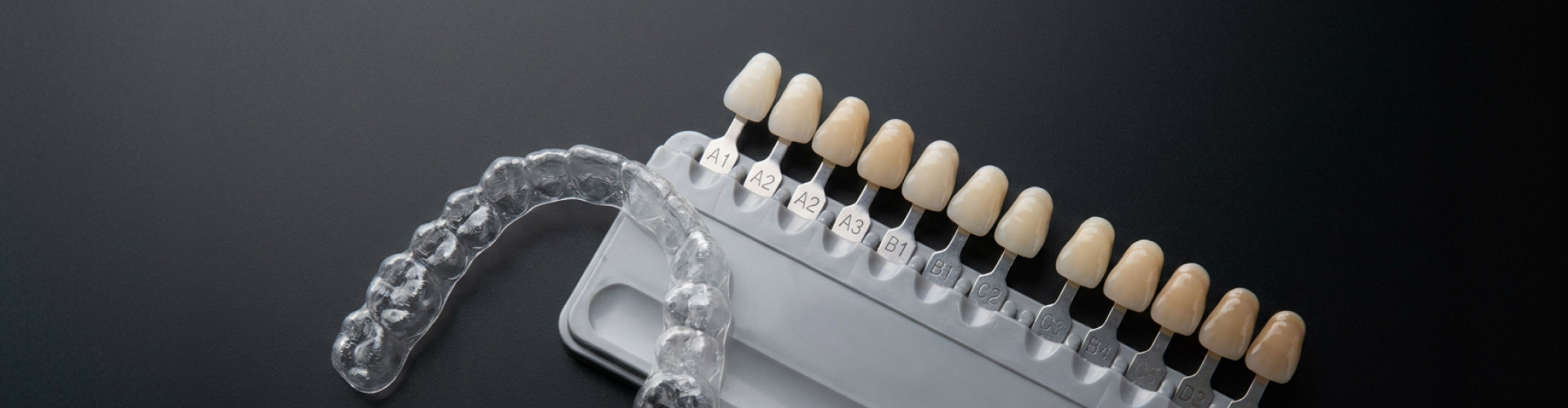
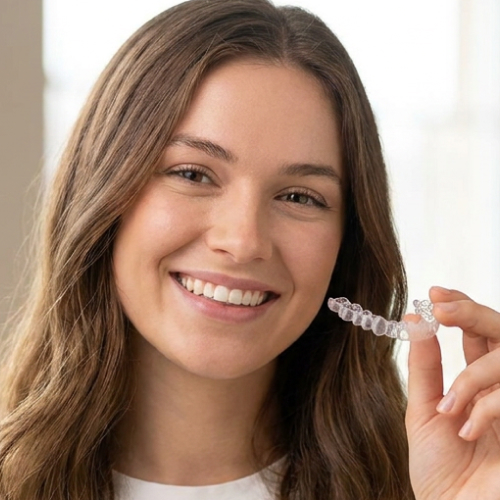
Invisalign and veneers solve different problems — one moves teeth, the other reshapes their appearance. The right choice depends on your specific anatomy, timeline, and long-term goals. For many patients in the Inland Empire, the best outcome combines both treatments in the correct sequence.
Most comparisons of Invisalign and veneers for gap closure ask one question: do you want fast results or gradual movement? That framing misses a critical piece of dental anatomy.
Orthodontists use a diagnostic tool called Bolton analysis to evaluate tooth-size-to-arch-length ratios. In plain terms, it measures whether your teeth are proportionally sized for your jaw. This matters enormously when choosing a treatment for gaps.
If your gaps exist because teeth are undersized — a condition called microdontia, often seen with peg-shaped lateral incisors — Invisalign can physically close those gaps, but the result may feel collapsed or unnatural. The arch narrows without the tooth proportions to support it. Conversely, closing wide gaps with veneers alone can produce oversized, unnaturally wide restorations.
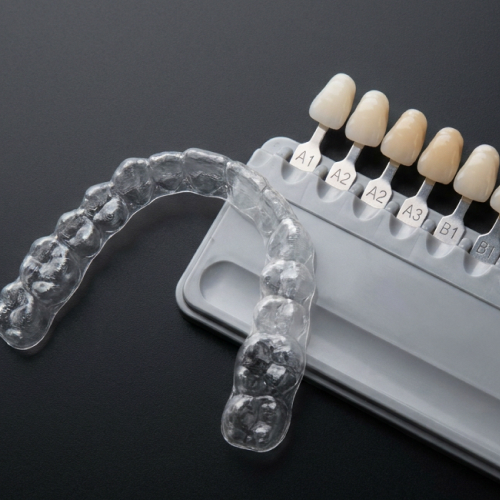
The clinical gold standard for these cases is pre-restorative Invisalign. Aligners first redistribute spacing evenly across the arch, creating room for porcelain veneers that are proportional rather than compensatory. As Invisalign.com notes, aligners can achieve the same positional results as braces — and that foundation matters before any cosmetic work begins.
For gaps caused purely by spacing or shifting with normal tooth dimensions, Invisalign alone is often sufficient. It preserves natural enamel, corrects bite alignment, and produces stable results over time. Veneers work best when the gap is driven by tooth-size deficiency or when other cosmetic goals — discoloration, worn edges, asymmetry — are part of the picture.
The takeaway: a proper evaluation of your tooth-size ratio, not just the gap's width, should drive the treatment recommendation.
Upfront comparisons between these two treatments can be misleading because they ignore what happens over the next two decades.
Invisalign is a finite orthodontic process. Once teeth are aligned, maintenance consists of wearing retainers — typically indefinitely at night — to hold the result. That is a predictable, low-maintenance commitment.
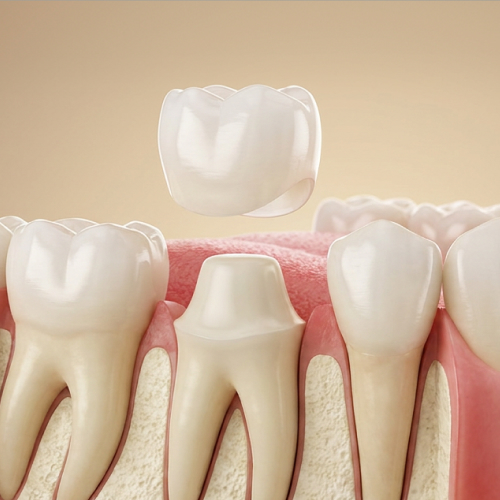
Veneers are a different category of commitment. According to a clinical overview, porcelain veneers last approximately 20 years with proper care, while composite veneers have a shorter lifespan. When a veneer fails — through chipping, debonding, or wear — it must be replaced. Because most porcelain veneer placements require enamel reduction, the underlying tooth is permanently altered and will always need a veneer going forward.
A full smile makeover typically involves six to eight veneers. That means replacement cycles, maintenance appointments, and the possibility of biological complications such as recurrent decay or sensitivity at the margin over time. None of this makes veneers a poor choice — they are genuinely transformative for the right candidate. But the long-term commitment is meaningfully different from a completed orthodontic case.
A CareCredit dental guide notes that ongoing maintenance and replacement considerations are part of the total picture. Patients weighing these two options deserve a clear-eyed view of that full timeline, not just a snapshot of the initial appointment. Staying current with your cleaning and exam appointments is one of the most effective ways to protect that investment over time.
If you are considering both treatments, clinical sequencing is not optional — it is the factor that determines whether your results hold up over time.
The standard of care is clear: complete Invisalign before placing veneers. Here is why this matters beyond the obvious logic of aligning teeth first.
Bonding Invisalign attachments to existing porcelain requires etching the veneer surface with hydrofluoric acid and applying a silane coupling agent. This process permanently strips the factory glaze from the porcelain, increasing the risk of debonding during treatment and compromising the veneer's surface integrity. Patients who pursue Invisalign after veneers face this risk — and it is rarely discussed in standard treatment consultations.
When Invisalign comes first, the benefits compound. Properly aligned roots allow for minimal tooth preparation at the veneer stage. Instead of aggressive enamel reduction to accommodate veneers on poorly positioned teeth, a dentist can place ultra-thin prepless or minimal-prep veneers — preserving more natural tooth structure and reducing long-term biological risk. For patients interested in exploring the full range of cosmetic options, aesthetic dentistry services can address everything from color and shape to symmetry and proportion.
As Invisalign.com explains, aligners are removable and designed to fit precisely over natural teeth. That precision is disrupted when veneers are already in place, particularly when attachments are needed for rotation or torque corrections.
Healthline's overview of dental veneers reinforces that porcelain veneers are considered an irreversible procedure due to enamel removal — which is exactly why the sequence of treatment matters so much. Protecting that enamel during the orthodontic phase preserves your options for a more conservative cosmetic outcome afterward. In some cases, patients may also benefit from teeth straightening braces as an alternative orthodontic path before committing to cosmetic restorations.
For patients already wearing veneers who want alignment correction, a candid conversation with a dental specialist is essential before starting any aligner therapy.
At Dental Specialists of Riverside, our team helps patients across Riverside and the Inland Empire navigate exactly these decisions — from Bolton analysis and Invisalign candidacy to veneer sequencing and long-term smile planning. If you are weighing Invisalign, veneers, or a combination of both, a dental implants or restorative consultation may also be part of your personalized treatment plan — and a personalized consultation is the right starting point.
This article is for informational purposes only and does not constitute dental or medical advice. Individual treatment needs vary. Please consult a licensed dental professional for a diagnosis and personalized treatment recommendations.
Fresh news from the dental world
Mon, Tues, Thur 9AM - 6PM
Weds 10AM - 7PM
Friday 8AM - 5PM
Sat & Sun Closed
Check out what our patients are saying in Riverside...


“What a Difference...”
“My wife and I recently decided to try teeth whitening here. Wow! What a difference. Thank you!”

“So Comfortable...”
"I have been coming here for years and I love this place. I feel so comfortable whenever I go into ortho. Everyone's really friendly! The ladies at the front desk are my favorite, they're always so helpful and always try their best to work around my schedule. Would definitely recommend!"

“Expert Care...”
“I have come a long way with all my dental issues. I’ve been able to take back control of my dental health because of the expert care I’ve received over the years at Dental Specialists of Riverside. I highly recommend this place because they won’t pressure you into stuff that you don’t need or that you are not ready for.”
..png)
“Never Disappointed...”
“I don’t have much time to waste, so I always get my whitening done by the good folks at Dental Specialists of Riverside. Never disappointed.”
“What a Difference...”
“My wife and I recently decided to try teeth whitening here. Wow! What a difference. Thank you!”
“So Comfortable...”
"I have been coming here for years and I love this place. I feel so comfortable whenever I go into ortho. Everyone's really friendly! The ladies at the front desk are my favorite, they're always so helpful and always try their best to work around my schedule. Would definitely recommend!"
Check out our accreditations, sources, and relationships in the wide world of dentistry...
..png)
..png)
..png)
Check us out and follow our Riverside, CA practice on social media...


..png)


