How Many Hours a Day Do You Really Need to Wear Invisalign Trays?
Wondering how long to wear Invisalign each day? Learn the daily wear rules, tray change schedule, and the 30-minute rule. Call our Riverside team today!
Read More
Laser therapy can dramatically reduce bacterial infection and support bone regeneration in advanced gum disease, but it is rarely a standalone "cure." Whether you can also get a gum graft depends entirely on a mandatory treatment sequence — grafting over active disease almost always fails.
This is the piece most patients never hear until they've already wasted time and money.
If you have both deep periodontal pockets and significant gum recession, the instinct is to address the visible problem first — the receding gumline. But placing a gum graft over active periodontitis is a clinical mistake. Uncontrolled bacterial infection destroys the tissue scaffold the graft needs to integrate. The procedure fails before it ever has a chance.
The correct clinical pathway follows three distinct phases:
Phase 1 — Eliminate the infection. Scaling and root planing removes bacterial biofilm and calculus from below the gumline. According to a StatPearls overview published on NCBI, sites with probing depths of 6mm or more will likely benefit from periodontal surgery after this initial non-surgical step. Laser pocket reduction — used adjunctively or as a primary surgical tool — kills residual bacteria, coagulates tissue, and begins stimulating a regenerative environment.
Phase 2 — Wait and re-evaluate. Tissue maturation takes 3–6 months. At re-evaluation, your periodontist measures pocket depths again. Grafting is only appropriate once pockets are consistently at or below 3mm. This window is non-negotiable.
Phase 3 — Restore the tissue. Once the bacterial environment is stable, soft tissue grafting becomes viable. A WebMD overview of gum tissue graft surgery explains that connective-tissue grafts, free gingival grafts, and pedicle grafts each address different recession patterns — and all require a healthy, infection-free foundation to succeed.
Skipping Phase 1 and 2 doesn't save time. It guarantees a second procedure.
Patients often receive quotes for "laser-assisted" treatment without understanding that this phrase covers wildly different procedures with completely different biological outcomes. Understanding gum disease gingivitis and its stages is essential before evaluating which laser approach is appropriate for your situation.
Diode laser bacterial reduction (LBR) is an adjunct to standard deep cleaning. A low-power diode laser decontaminates the periodontal pocket during scaling — reducing bacterial load modestly. It is not surgery. It does not regenerate bone. The laser wavelength used here cannot penetrate to the depth or tissue type required for regeneration.
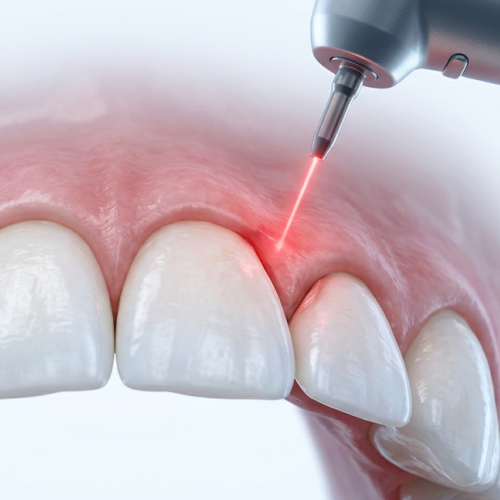
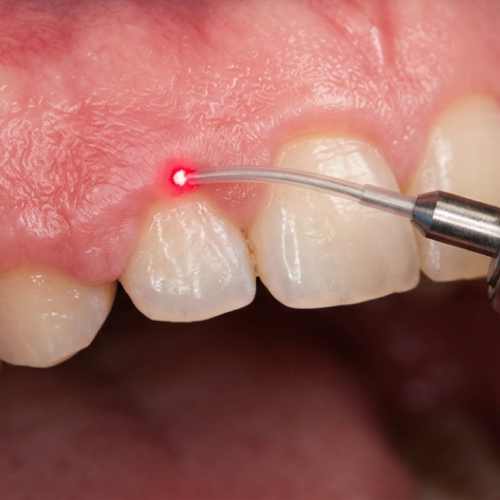
True regenerative laser surgery — specifically Nd:YAG-based protocols like LANAP (Laser-Assisted New Attachment Procedure) — operates at a fundamentally different biological level. A Healthline overview of laser gum surgery describes how the fiber optic tip is placed directly into the periodontal pocket, where it selectively removes diseased tissue while leaving healthy tissue intact, kills bacteria, and creates a stable clot that promotes reattachment.
The distinction matters clinically because of what each approach can actually achieve in deep pockets (≥6mm). Traditional resective flap surgery cuts away tissue to reduce pocket depth — effective, but the healing that follows typically forms a "long junctional epithelium," essentially scar tissue. It repairs the problem rather than reversing it, and often leaves roots exposed and sensitive.
Regenerative laser protocols, by contrast, aim for true histological regeneration: the formation of new cementum, new periodontal ligament fibers, and new alveolar bone along the root surface. This is a biologically meaningful difference — not a marketing claim. When evaluating your options, ask your periodontist specifically which laser wavelength will be used and what the intended biological outcome is.
Understanding the honest scope of laser treatment helps patients make better decisions. Healthline's laser dentistry overview notes that the FDA has approved laser dentistry as a treatment option for several dental conditions, including gum disease — but approval is not the same as a guarantee of cure.
What lasers do well:
Honest limitations:
WebMD's resource on laser use in dentistry notes that the American Dental Association remains "cautiously optimistic" — and that lasers do not eliminate the need for anesthesia or replace every traditional procedure. Lasers also cannot address bone defects in isolation; severely compromised bone may still require grafting or guided tissue regeneration alongside laser treatment.
For moderate to advanced periodontitis, laser therapy is most accurately described as a powerful tool within a comprehensive treatment plan — not a single-session solution. The severity of bone loss, pocket depth, and your overall systemic health all influence what's realistically achievable. In some cases, patients with significant bone loss may also need to consider dental implants or tooth extraction for teeth that cannot be saved, making early intervention all the more critical.
Maintaining a consistent schedule of cleaning and exam appointments is one of the most effective ways to catch periodontal disease before it progresses to the point where surgical intervention becomes necessary.
If you've been told you need gum surgery, laser treatment, or a gum graft — or if you're simply noticing gum recession and want answers — Dental Specialists of Riverside is here to help. Our team serves patients throughout Riverside and the broader Inland Empire with periodontal care that's sequenced correctly from the start. If you're experiencing sudden pain or swelling, don't wait — reach out about a dental emergency evaluation right away. Contact us to schedule a comprehensive evaluation and find out exactly where you stand.
This article is intended for informational purposes only and does not constitute medical or dental advice. Always consult a licensed dental professional for diagnosis and personalized treatment recommendations.
Fresh news from the dental world

Mon, Tues, Thur 9AM - 6PM
Weds 10AM - 7PM
Friday 8AM - 5PM
Sat & Sun Closed
Check out what our patients are saying in Riverside...


“What a Difference...”
“My wife and I recently decided to try teeth whitening here. Wow! What a difference. Thank you!”

“So Comfortable...”
"I have been coming here for years and I love this place. I feel so comfortable whenever I go into ortho. Everyone's really friendly! The ladies at the front desk are my favorite, they're always so helpful and always try their best to work around my schedule. Would definitely recommend!"

“Expert Care...”
“I have come a long way with all my dental issues. I’ve been able to take back control of my dental health because of the expert care I’ve received over the years at Dental Specialists of Riverside. I highly recommend this place because they won’t pressure you into stuff that you don’t need or that you are not ready for.”
..png)
“Never Disappointed...”
“I don’t have much time to waste, so I always get my whitening done by the good folks at Dental Specialists of Riverside. Never disappointed.”
“What a Difference...”
“My wife and I recently decided to try teeth whitening here. Wow! What a difference. Thank you!”
“So Comfortable...”
"I have been coming here for years and I love this place. I feel so comfortable whenever I go into ortho. Everyone's really friendly! The ladies at the front desk are my favorite, they're always so helpful and always try their best to work around my schedule. Would definitely recommend!"
Check out our accreditations, sources, and relationships in the wide world of dentistry...
..png)
..png)
..png)
Check us out and follow our Riverside, CA practice on social media...

..png)


