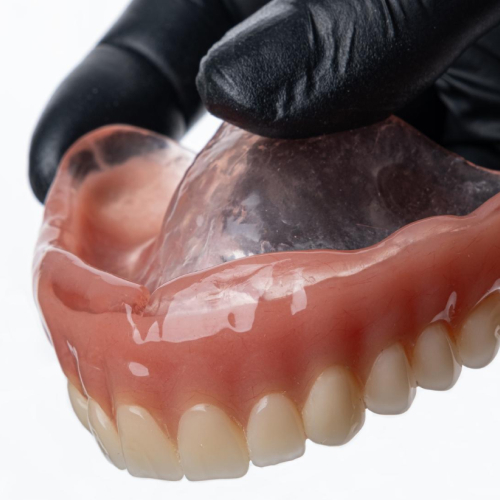
Denture Care Mistakes That Could Be Quietly Damaging Your Health
Are your denture habits harming your health? Learn the common denture care mistakes to avoid and schedule your checkup with our Riverside specialists today.
Read More
Most denture wearers underestimate the daily care their prosthetics require — and some common habits actively accelerate bone loss and infection. This guide covers the cleaning steps that actually work, the truth about adhesives, and why removing your dentures at night matters more than you might think.
For Riverside-area patients, here is something most denture wearers don't hear until real damage is done: using extra adhesive to stabilize a loose denture doesn't fix the problem. It accelerates it.
When a denture fits poorly, it rocks unevenly against your gum ridge. That uneven pressure signals the underlying bone to resorb — to shrink away. According to the ADA, ill-fitting dentures can contribute to the development of mouth sores and, with prolonged use, significant bone loss. Adhesive masks the rocking sensation, which means you feel stable while the destruction continues quietly underneath.
A simple self-test: Place your denture in without any adhesive. Press down and rock it gently side to side. If it lifts, shifts, or produces a clicking sensation, that's a loose denture — not an adhesive deficiency. Now check your adhesive usage: if you're applying more than three or four pea-sized dollops per denture and the tube runs out in under seven weeks, you are almost certainly compensating for a poor fit rather than supplementing a good one.
Adhesive is genuinely useful in specific situations — dry mouth, minor stability concerns during public speaking, or the early adjustment period with new dentures. Research published in PMC confirms that adhesives improve retention, bite force, and quality of life when used on well-fitting dentures. The key phrase is well-fitting.
If you're removing your denture each night and finding thick adhesive residue caked on the tissue surface, that's your signal to call a prosthodontist about a reline or replacement — not to buy a larger tube.
Removing adhesive residue from your gums: This step gets almost no attention in standard guides. After removing your denture, the adhesive polymer residue left on your palate and gum ridges is water-resistant and won't rinse away easily. Gently massage the area with a small amount of coconut or olive oil on a soft gauze square. Oils break down the hydrophilic polymer matrix of adhesive far more effectively than water alone. Follow with a soft-bristled gum brush using warm water. Never scrape with fingernails or rough paper towels — this creates micro-abrasions where bacteria and Candida readily colonize.
Brushing your dentures is not enough on its own. The science is clear: plaque and biofilm require both mechanical and chemical removal to be fully disrupted. A Healthline overview on denture care notes that brushing alone doesn't clean dentures — thorough nightly soaking is equally essential.
The correct daily protocol:
One important note for patients with 3D-printed digital dentures: Modern practices increasingly fabricate dentures from light-cured photopolymer resins rather than traditional heat-cured PMMA acrylic. These materials have different surface chemistry. High-oxygenating effervescent tablets and alcohol-based rinses can cause micro-cracking and color leaching in printed resins over time. If you're unsure which material your dentures are made from, ask your provider — and use a gentle enzymatic soak rather than a peroxide-based tablet until you know.
Brush your gums, tongue, and palate every morning before reinserting your dentures. Mouth Healthy from the ADA emphasizes this step specifically: stimulating circulation in oral tissues and removing plaque from soft tissues is as important as cleaning the prosthetic itself. Staying current with your cleaning and exam appointments also helps catch tissue changes early before they become serious problems.
Sleeping in your dentures increases your risk of denture stomatitis, bacterial pneumonia, and accelerated bone resorption. A 2021 study referenced by the National Institute on Aging found that tooth loss is associated with higher dementia risk — but notably, participants who used dentures did not carry that same elevated risk, suggesting that proper prosthetic use and oral hygiene together protect more than most people realize.
Removing dentures at night gives oral tissues a recovery window. Constant denture contact reduces blood flow to the gum ridges. Over months and years, that contributes to the same bone resorption cycle described above.
When you remove your dentures:
Partial denture wearers should also remove clasps carefully — never bite down to seat a partial. WebMD's guide on dentures notes that forcing a partial into place by biting can bend or break the metal clasps and damage adjacent natural teeth. If a natural tooth becomes severely compromised in the process, a tooth extraction may ultimately be required — an outcome that's entirely avoidable with careful handling.
Regular dental checkups remain essential even for full denture wearers. Bone changes, tissue irritation, and denture fit all require professional evaluation — not just more adhesive. Signs of gum disease gingivitis can develop even without natural teeth present, making routine professional monitoring especially important for denture wearers.
If your dentures feel loose, require increasing amounts of adhesive, or haven't been professionally evaluated in over a year, it's time for an appointment. For patients who have experienced significant tooth loss, dental implants may also be worth discussing as a longer-term solution to support bone health and stability. Dental Specialists of Riverside serves patients throughout Riverside and the broader Inland Empire with expert prosthetic care, including denture fittings, relines, and full oral health evaluations. Don't wait until discomfort becomes a larger problem — reach out today.
This article is for informational purposes only and does not constitute professional dental or medical advice. Always consult a licensed dental provider for guidance specific to your oral health needs.
Fresh news from the dental world


Mon, Tues, Thur 9AM - 6PM
Weds 10AM - 7PM
Friday 8AM - 5PM
Sat & Sun Closed
Check out what our patients are saying in Riverside...


“What a Difference...”
“My wife and I recently decided to try teeth whitening here. Wow! What a difference. Thank you!”

“So Comfortable...”
"I have been coming here for years and I love this place. I feel so comfortable whenever I go into ortho. Everyone's really friendly! The ladies at the front desk are my favorite, they're always so helpful and always try their best to work around my schedule. Would definitely recommend!"

“Expert Care...”
“I have come a long way with all my dental issues. I’ve been able to take back control of my dental health because of the expert care I’ve received over the years at Dental Specialists of Riverside. I highly recommend this place because they won’t pressure you into stuff that you don’t need or that you are not ready for.”
..png)
“Never Disappointed...”
“I don’t have much time to waste, so I always get my whitening done by the good folks at Dental Specialists of Riverside. Never disappointed.”
“What a Difference...”
“My wife and I recently decided to try teeth whitening here. Wow! What a difference. Thank you!”
“So Comfortable...”
"I have been coming here for years and I love this place. I feel so comfortable whenever I go into ortho. Everyone's really friendly! The ladies at the front desk are my favorite, they're always so helpful and always try their best to work around my schedule. Would definitely recommend!"
Check out our accreditations, sources, and relationships in the wide world of dentistry...
..png)
..png)
..png)
Check us out and follow our Riverside, CA practice on social media...


..png)