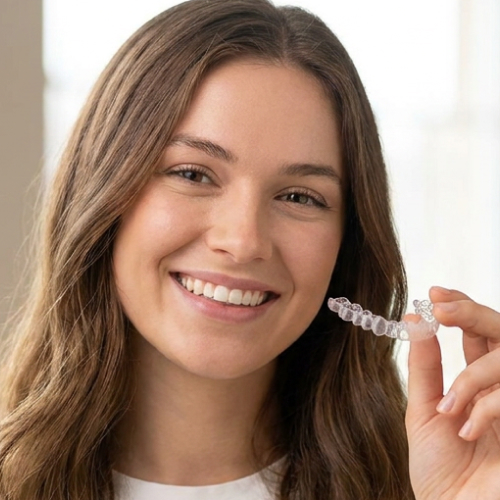
How Many Hours a Day Do You Really Need to Wear Invisalign Trays?
Wondering how long to wear Invisalign each day? Learn the daily wear rules, tray change schedule, and the 30-minute rule. Call our Riverside team today!
Read More
Not all clear aligners are built the same — the plastic, the process, and the professional oversight differ significantly between Invisalign and mail-order kits. Understanding those differences helps you choose the option that actually moves your teeth safely and predictably. If you're exploring orthodontic options, Invisalign offers a clinically supervised path that mail-order kits simply can't replicate.
Most people assume clear aligners are just clear plastic trays. The material differences, however, directly affect how well your teeth move — and how much it hurts along the way.
Mail-order brands and budget alternatives commonly use rigid, single-layer PETG plastic. This material exerts intense force on day one, which is why new aligners from these kits often feel painful immediately. The problem: PETG suffers from rapid "force decay." By day three, the aligner has largely lost its active moving power. You're wearing a tray for two weeks that stopped working on day three.
Invisalign uses a proprietary multilayer polyurethane-polyester copolymer called SmartTrack. It's engineered to deliver gentle, continuous force across the entire 7-to-14-day wear cycle. The material stretches and recovers, maintaining consistent pressure rather than spiking and fading. According to Healthline, SmartTrack is a flexible thermoplastic specifically designed to make tooth movement more predictable and comfortable.
The practical result: Invisalign's material is more comfortable on day one and more effective on day seven. That's not a marketing claim — it's basic polymer science applied to orthodontic force delivery.
Here's what most comparison articles skip entirely: plastic alone cannot perform complex tooth movements.
Rotating a rounded canine tooth, extruding a tooth vertically, or correcting a true bite problem requires physical "handles" on the tooth surface. Invisalign uses tooth-colored composite attachments — small, precisely shaped bumps bonded directly to your teeth by a licensed dental professional. These attachments give the aligner tray something to grip, enabling movements that friction-only plastic simply cannot generate.
Mail-order aligners are smooth trays with no attachments. They can tip teeth forward or backward. That's roughly the extent of it. Teeth that need rotation, intrusion, or extrusion won't respond to friction-only trays — and forcing the issue can move roots out of supporting bone without moving the crown visibly, creating damage that isn't obvious until much later.
Cleveland Clinic explains that clear aligners treat a range of alignment issues, but the complexity of your case determines which tool is appropriate. A provider who examines you in person can assess whether your specific tooth movements require attachments — something a mail-order photo review cannot determine.
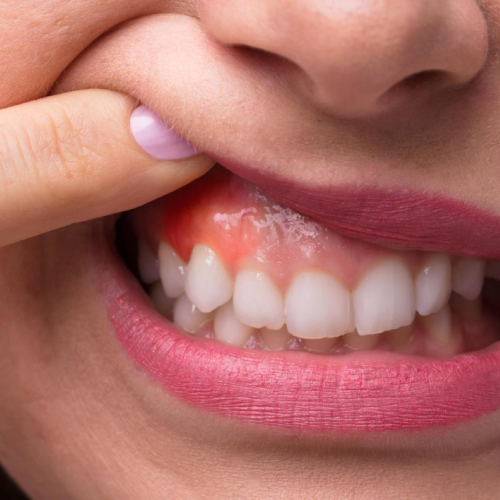
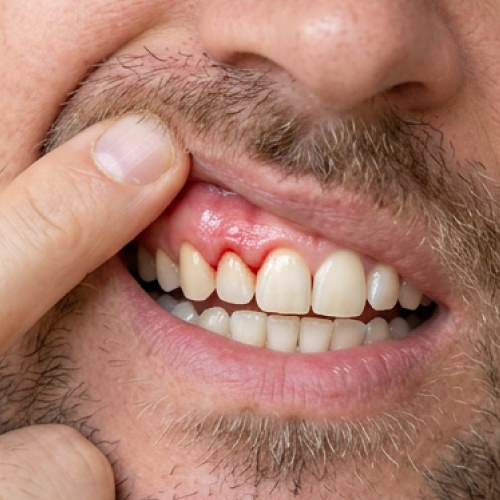
WebMD notes that adults often have pre-existing dental conditions — including gum disease — that make professional evaluation especially important before starting any orthodontic treatment.
Teeth rarely move exactly as a 3D computer model predicts. Over 70% of patients need mid-course corrections — additional trays to address stubborn teeth that didn't shift as planned.
With Invisalign Comprehensive, refinements are typically included for up to five years. Your provider rescans your teeth, updates the digital treatment plan, and fabricates new trays — without triggering a separate charge in most cases.
Mail-order kits handle this very differently. The fine print on many plans requires strict compliance with progress photo uploads, check-in schedules, and response windows. Miss a single upload, and you may forfeit your guarantee. Need extra trays because your teeth stopped tracking? That often means paying per refinement set, submitting a new impression kit, and waiting weeks for new trays — all out of pocket.
Before signing any aligner contract, ask these questions directly:
A Healthline review of invisible braces options highlights that Invisalign's in-office model means a doctor reviews your progress at each appointment — a layer of oversight that remote-only services structurally cannot replicate. This is also why routine cleaning and exam visits remain important throughout any orthodontic treatment.
Mail-order aligners are marketed broadly, but they're genuinely appropriate for a narrow range of cases: minor spacing, very mild crowding, and small cosmetic adjustments in otherwise healthy mouths with no bite issues.
Invisalign treats a significantly wider range of conditions — crowding, spacing, overbite, underbite, open bite, and more — particularly when combined with attachments and, in some cases, rubber bands. For patients whose cases fall outside what aligners can address, teeth straightening braces remain a highly effective alternative. Healthline's overview of Invisalign rubber bands explains how elastics can address bite corrections that plastic trays alone cannot achieve.
If you have gum disease, bone loss, missing teeth, or any bite discrepancy, starting mail-order treatment without a clinical exam carries real risk. Movement without monitoring can accelerate existing problems invisibly. In some cases, unaddressed issues may eventually require a tooth extraction if damage progresses undetected.
For Riverside-area patients weighing these options, the most important first step is a professional assessment — not a selfie submitted to an app.
Dental Specialists of Riverside serves patients throughout Riverside and the surrounding Inland Empire with comprehensive orthodontic evaluations. If you're considering clear aligners or other aesthetic dentistry solutions, schedule a consultation to find out exactly what your teeth need — and which treatment will actually deliver it.
This article is for informational purposes only and does not constitute dental or medical advice. Always consult a licensed dental professional before beginning any orthodontic treatment.
Fresh news from the dental world


Mon, Tues, Thur 9AM - 6PM
Weds 10AM - 7PM
Friday 8AM - 5PM
Sat & Sun Closed
Check out what our patients are saying in Riverside...


“What a Difference...”
“My wife and I recently decided to try teeth whitening here. Wow! What a difference. Thank you!”

“So Comfortable...”
"I have been coming here for years and I love this place. I feel so comfortable whenever I go into ortho. Everyone's really friendly! The ladies at the front desk are my favorite, they're always so helpful and always try their best to work around my schedule. Would definitely recommend!"

“Expert Care...”
“I have come a long way with all my dental issues. I’ve been able to take back control of my dental health because of the expert care I’ve received over the years at Dental Specialists of Riverside. I highly recommend this place because they won’t pressure you into stuff that you don’t need or that you are not ready for.”
..png)
“Never Disappointed...”
“I don’t have much time to waste, so I always get my whitening done by the good folks at Dental Specialists of Riverside. Never disappointed.”
“What a Difference...”
“My wife and I recently decided to try teeth whitening here. Wow! What a difference. Thank you!”
“So Comfortable...”
"I have been coming here for years and I love this place. I feel so comfortable whenever I go into ortho. Everyone's really friendly! The ladies at the front desk are my favorite, they're always so helpful and always try their best to work around my schedule. Would definitely recommend!"
Check out our accreditations, sources, and relationships in the wide world of dentistry...
..png)
..png)
..png)
Check us out and follow our Riverside, CA practice on social media...

..png)


