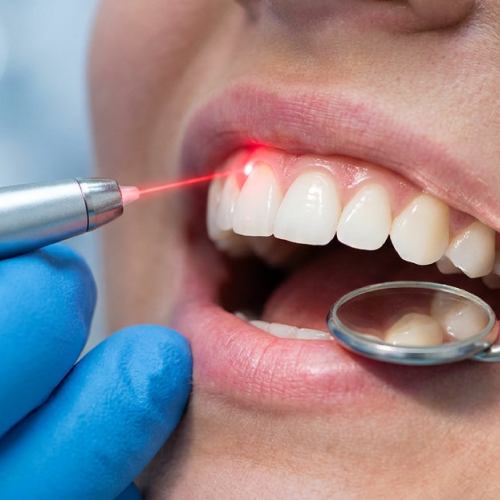
Is Gum Contouring Permanent? What Actually Determines How Long Results Last
Discover if gum contouring is permanent and what factors influence your long-term results. Learn if gums can grow back and book your consultation in Riverside!
Read More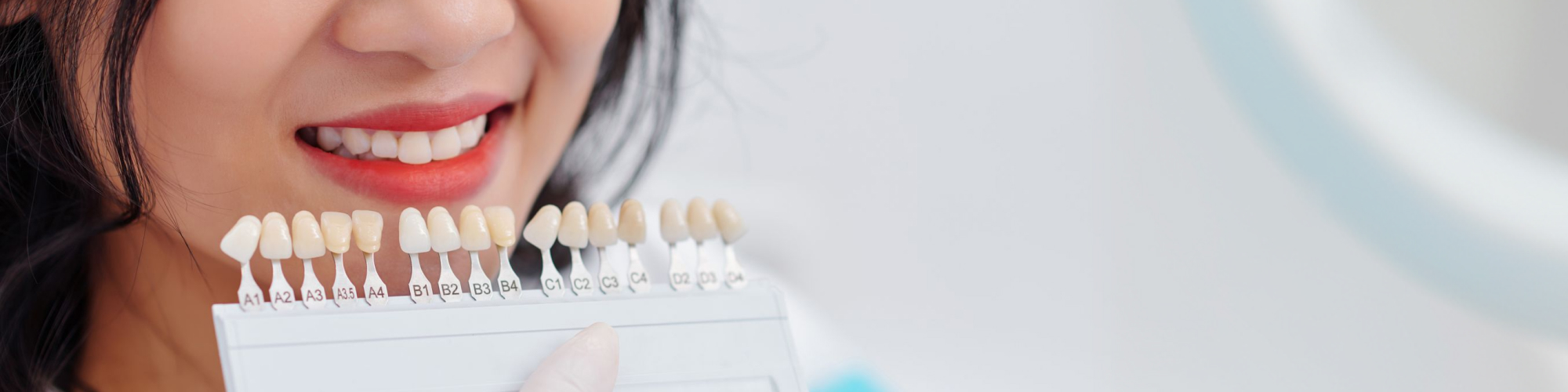
Porcelain veneers can close gaps and mask mild misalignment, but the biological cost of "instant orthodontics" is far higher than most patients realize. Whether you're considering veneers alone or after Invisalign, the sequencing and prep depth decisions made at your consultation directly affect how much healthy enamel you keep for life.
This is the conversation I have with nearly every patient who comes in asking about veneers for crooked or rotated teeth — and it's the one most online resources skip entirely.
Cleveland Clinic explains that veneers are cosmetic restorations bonded to the front surface of teeth. To place them, a dentist removes a thin layer of enamel so the shell sits flush and natural-looking. On a tooth that's already in good alignment, that reduction is minimal — typically 0.3mm to 0.5mm, well within the enamel layer.
But on a tooth that's rotated or protruding? The math changes dramatically.
To make a crooked tooth look straight behind a veneer, I have to shave away significantly more structure on the part of the tooth that sticks out — sometimes 1.0mm or more. That's not a cosmetic tweak; that's reaching into dentin territory, which increases sensitivity risk and weakens the foundation the veneer bonds to.
This is exactly why I tell patients that Invisalign before veneers isn't just about aesthetics. It's about preserving your enamel for the veneer's foundation. When teeth are straightened first, every tooth presents a flat, even surface. Prep depths stay conservative and uniform. The veneer bonds to healthy enamel, which gives you better long-term success rates as research published in PMC confirms. Skipping orthodontics to save time often means sacrificing far more tooth structure than necessary — a trade-off that can never be undone.
For patients with mild crowding and no significant color or shape concerns, clear aligners alone may be the right answer. For patients who want to address both alignment and the color, shape, or length of their teeth, the combination approach is almost always more conservative in the long run.
Diastema — the clinical term for a gap between teeth — is one of the most common cosmetic concerns I see in Riverside and throughout the Inland Empire. For Riverside-area patients, Cleveland Clinic notes that gaps are most common between the two upper front teeth and are usually a cosmetic concern rather than a health issue.
Veneers can close that gap beautifully. But there's a complication most patients don't hear about until after the fact: black triangles.
When a veneer is simply widened at the biting edge to bridge a gap, the base of the tooth — where it meets the gum — stays the same width. The result is a tooth that looks blocky at the top and leaves a small triangular void at the gumline. WebMD describes these open gingival embrasures as spaces where gum tissue fails to fill the natural gap between teeth. They trap food, complicate cleaning, and can become a site for localized gum disease inflammation over time.
Preventing this requires a technique called subgingival contouring — shaping the veneer so it begins under the gumline, not at it. By extending the contact point of the veneer downward, we guide the papilla (the small triangle of pink gum tissue between teeth) to fill the space naturally. It takes more planning and a more precise impression, but it's the difference between a result that looks natural and one that looks like two white rectangles sitting next to each other.
When I plan diastema closures, I always use a diagnostic wax-up or digital mock-up first. This lets patients preview the emergence profile — how the tooth exits the gum — before we commit to any irreversible preparation.
Patients finishing Invisalign often come to me ready to move straight into veneers. I understand the eagerness — you've spent months in aligners and you want your final smile now. But there's a critical sequencing issue that most articles don't address, and ignoring it puts your orthodontic results at risk.
Healthline's overview of no-prep veneers notes that teeth are most responsive to movement when preparation begins. What that means clinically: immediately after Invisalign, your teeth are at peak mobility. The roots haven't fully stabilized in their new positions. This is precisely when you cannot go without retention — even for two weeks.
Here's the problem. Once I prep your teeth for veneers and take impressions, the lab typically needs 10 to 14 days to fabricate your permanent restorations. Your Invisalign retainers — whether Vivera or standard clear — were scanned to fit your pre-veneer tooth shapes. After prep, those retainers no longer fit. If you go without retention during that window, teeth can drift.
My solution is what I call a temporary retainer strategy. After prep, I place a transitional retention device — either a modified Essix retainer trimmed to accommodate the prepped teeth, or a bonded lingual wire behind the front teeth — to hold your Invisalign results in place while the lab works. Temporary veneers also serve a retention function during this period.
Critically, the scan for your final retainer — the one you'll wear long-term to protect both your orthodontic result and your veneers — can only happen after the permanent veneers are bonded. That scan captures your new tooth shapes accurately. Mouthhealthy.org from the ADA reinforces that proper fit and bite verification after permanent bonding are essential steps, not afterthoughts.
Getting this sequence right is one of the most detail-sensitive parts of the veneer process. It's worth discussing explicitly at your consultation so there are no gaps in your retention plan — literally or figuratively.
Not every gap or alignment issue is best solved with veneers. Part of my role is helping patients understand where veneers excel and where a different approach serves them better.
For small gaps with healthy, well-shaped teeth, dental bonding is often the most conservative option. According to Healthline's overview of gap treatment options, bonding applies composite resin directly to teeth without removing enamel, costs significantly less than veneers, and can be completed in a single visit. The trade-off is longevity — bonding typically lasts three to ten years before needing touch-ups, while porcelain veneers routinely last ten to fifteen years or longer.
For multiple gaps or significant crowding, teeth straightening braces or clear aligners address the underlying tooth position rather than masking it. This matters especially if bite alignment is involved — veneers change the look of teeth, but they don't correct how upper and lower arches meet.
Veneers make the most sense when a patient wants to simultaneously close a gap and improve tooth color, shape, or length — changes that orthodontics alone can't achieve. In those cases, the combination of aligned teeth plus carefully planned veneers produces results that are both beautiful and biologically sound.
Every treatment plan I develop starts with an honest conversation about what you're hoping to achieve, what your teeth can support, and what trade-offs you're willing to make. That's how we find the right answer for your specific situation.
If you're considering veneers to close a gap, correct mild misalignment, or complete your smile after Invisalign, I'd encourage you to start with a thorough cleaning and exam before committing to any treatment. The details — prep depth, retention planning, emergence profile — matter far more than most people realize, and getting them right from the start protects your long-term oral health.
Our team at Dental Specialists of Riverside works with patients throughout Riverside, Corona, and the broader Inland Empire to build treatment plans that are both cosmetically excellent and biologically conservative. Reach out to schedule your consultation — we're here to help you make an informed decision.
Medical disclaimer: This article is intended for informational purposes only and does not constitute professional dental or medical advice. Individual results vary. Please consult a licensed dental professional for diagnosis and personalized treatment recommendations.
Fresh news from the dental world



Mon, Tues, Thur 9AM - 6PM
Weds 10AM - 7PM
Friday 8AM - 5PM
Sat & Sun Closed
Check out what our patients are saying in Riverside...
..png)

“Never Disappointed...”
“I don’t have much time to waste, so I always get my whitening done by the good folks at Dental Specialists of Riverside. Never disappointed.”

“So Comfortable...”
"I have been coming here for years and I love this place. I feel so comfortable whenever I go into ortho. Everyone's really friendly! The ladies at the front desk are my favorite, they're always so helpful and always try their best to work around my schedule. Would definitely recommend!"

“Expert Care...”
“I have come a long way with all my dental issues. I’ve been able to take back control of my dental health because of the expert care I’ve received over the years at Dental Specialists of Riverside. I highly recommend this place because they won’t pressure you into stuff that you don’t need or that you are not ready for.”

“What a Difference...”
“My wife and I recently decided to try teeth whitening here. Wow! What a difference. Thank you!”
“Never Disappointed...”
“I don’t have much time to waste, so I always get my whitening done by the good folks at Dental Specialists of Riverside. Never disappointed.”
“So Comfortable...”
"I have been coming here for years and I love this place. I feel so comfortable whenever I go into ortho. Everyone's really friendly! The ladies at the front desk are my favorite, they're always so helpful and always try their best to work around my schedule. Would definitely recommend!"
Check out our accreditations, sources, and relationships in the wide world of dentistry...
..png)
..png)
..png)
Check us out and follow our Riverside, CA practice on social media...


..png)