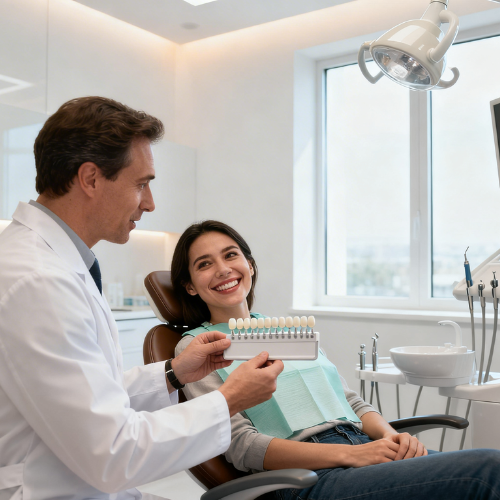
Do Veneers Stain Over Time? What You Should Know Before Getting One
Wondering if veneers stain over time? Dental Specialists of Riverside explains what causes discoloration and how to protect your smile in Riverside, CA.
Read More
Written by Dr. David Won, DDS
Medically Reviewed by Dr. Chad Hawkins, DDS | Orthodontist
If you're considering veneers here in Riverside, one of the first questions I hear is: "Will they stain like my natural teeth?" It's a fair concern. You're investing real money into your smile, and the last thing you want is to watch it yellow over coffee and red wine a few years down the road.
Short answer? Veneers resist staining better than natural enamel — but they're not completely immune. And the type of veneer you choose matters quite a bit, as Cleveland Clinic notes in their overview of dental veneers.
I've worked with patients across the Inland Empire who were surprised to learn that staining, when it does happen, usually shows up at the edges rather than across the whole surface. That distinction changes everything about how we prevent it and treat it.
Let me break this down properly.
Honestly, yes — but not in the way most people expect.
Porcelain veneers themselves, especially porcelain ones, are highly resistant to surface staining. The ceramic material is dense and non-porous, which means coffee, tea, and red wine have a much harder time penetrating the surface compared to natural enamel. But here's the thing — staining can still develop, just usually at the margins.
The margins are where the veneer meets your natural tooth. Over time, the resin cement used to bond the veneer can absorb pigments from food and drink. That's where you'll often see a darker line or shadow creeping in, sometimes after three to four years, depending on habits.
I had a patient last month who came in frustrated because her veneers looked "dingy" around the edges after about five years. She was a daily coffee drinker and a smoker — two of the biggest culprits. Not always the veneer's fault. Sometimes it's the lifestyle around it.
What accelerates marginal staining?
And bruxism is worth flagging separately. Grinding doesn't just chip veneers — it can compromise the seal between the veneer and tooth, creating tiny pathways for staining agents to sneak in. At least in my experience, patients who grind and don't wear a nightguard tend to see earlier deterioration.
Actually, scratch that — it's not just earlier deterioration. It's a different category of problem entirely. Grinding changes the failure mode from cosmetic to structural.
Bottom line? Veneers don't stain the way natural teeth do, but they're not maintenance-free either. Avoiding staining agents, keeping up with cleanings, and protecting the margins goes a long way.
Yes. And the difference is more significant than most patients realize.
Porcelain veneers are made from fired ceramic, which has an extremely low porosity. That means staining molecules — from coffee, wine, berries, etc. — can't absorb into the material the way they can with composite resin. Studies have shown that 89.3% of porcelain veneers showed no significant changes like marginal staining or chipping after five years. That's a strong track record.
Composite veneers, on the other hand, are made from resin — the same basic material used in tooth-colored fillings. Resin is more porous. It absorbs pigments more readily, and it tends to show surface staining within a few years, sometimes sooner if you're a heavy coffee or tea drinker.
Here's a quick comparison worth keeping in mind:
Look, composite veneers aren't a bad option. They're more conservative, reversible in some cases, and can be repaired chairside without replacing the whole restoration. For younger patients or those who aren't ready to commit to porcelain, they make sense — which, fair enough, is a real consideration.
But if stain resistance is your priority? Porcelain wins. Every time.
I'm not 100% sure why some clinicians still recommend composite for patients who drink coffee daily without a serious conversation about staining expectations, but my theory is that the lower upfront cost overshadows the long-term maintenance conversation.
Can you whiten composite veneers when they stain? Not with traditional whitening. The resin doesn't respond to peroxide the way enamel does. So once composite discolors, polishing or replacement are usually your only options.
This one surprises people. A lot.
You can have veneers with zero surface staining and still notice that your smile looks darker or more shadowed than it used to. Why does that happen?
A few reasons, and they're worth understanding before you assume something went wrong with your veneers.
Cement discoloration. The resin cement used to bond your veneer to the tooth can shift color over time. It's sandwiched between the veneer and the tooth, so you can't see it directly — but its color affects how light passes through the porcelain. Darker cement equals a darker-looking veneer, even if the surface is pristine.
Changes in the underlying tooth. Natural teeth can continue to darken with age, especially if there's been past trauma or the pulp has changed. Since porcelain is translucent, some of that underlying color can show through.
Gum recession. As gums recede — which can happen with age, aggressive brushing, or periodontal issues — the root surface below the veneer becomes visible. Root surfaces are naturally darker and more yellow than enamel. Suddenly your veneer looks like it ends abruptly at a dark line.
Veneer thickness and translucency. Thinner veneers transmit more light, which means more of the underlying tooth color comes through. This isn't a defect — it's physics.
Are these problems fixable? Sometimes. Cement-related darkening might require replacement. Gum recession can be addressed with periodontal treatment. And for patients in Riverside dealing with these concerns, a proper evaluation is the only way to know what's actually driving the change.
Here's the thing — darker-looking veneers don't always mean failed veneers. The diagnosis matters before the treatment does. For a deeper look at what to expect before committing, this overview of dental veneers in Riverside covers the key considerations worth reviewing.
If you're noticing changes in your veneers — or you're still weighing your options before getting them — our team at Dental Specialists of Riverside is here to help. We work with patients throughout Riverside and the broader Inland Empire, including Corona, and we take the time to match the right restoration to your actual lifestyle, not just your budget.
Reach out to Dental Specialists of Riverside to schedule a consultation. Whether you're dealing with staining, discoloration, or just want honest answers about what veneers can and can't do for you, we're ready to have that conversation.
This content is for informational purposes only and does not replace professional medical advice, diagnosis, or treatment. Always consult with a qualified healthcare provider.
Fresh news from the dental world






Mon, Tues, Thur 9AM - 6PM
Weds 10AM - 7PM
Friday 8AM - 5PM
Sat & Sun Closed
Check out what our patients are saying in Riverside...


“What a Difference...”
“My wife and I recently decided to try teeth whitening here. Wow! What a difference. Thank you!”

“So Comfortable...”
"I have been coming here for years and I love this place. I feel so comfortable whenever I go into ortho. Everyone's really friendly! The ladies at the front desk are my favorite, they're always so helpful and always try their best to work around my schedule. Would definitely recommend!"

“Expert Care...”
“I have come a long way with all my dental issues. I’ve been able to take back control of my dental health because of the expert care I’ve received over the years at Dental Specialists of Riverside. I highly recommend this place because they won’t pressure you into stuff that you don’t need or that you are not ready for.”
..png)
“Never Disappointed...”
“I don’t have much time to waste, so I always get my whitening done by the good folks at Dental Specialists of Riverside. Never disappointed.”
“What a Difference...”
“My wife and I recently decided to try teeth whitening here. Wow! What a difference. Thank you!”
“So Comfortable...”
"I have been coming here for years and I love this place. I feel so comfortable whenever I go into ortho. Everyone's really friendly! The ladies at the front desk are my favorite, they're always so helpful and always try their best to work around my schedule. Would definitely recommend!"
Check out our accreditations, sources, and relationships in the wide world of dentistry...
..png)
..png)
..png)
Check us out and follow our Riverside, CA practice on social media...


..png)