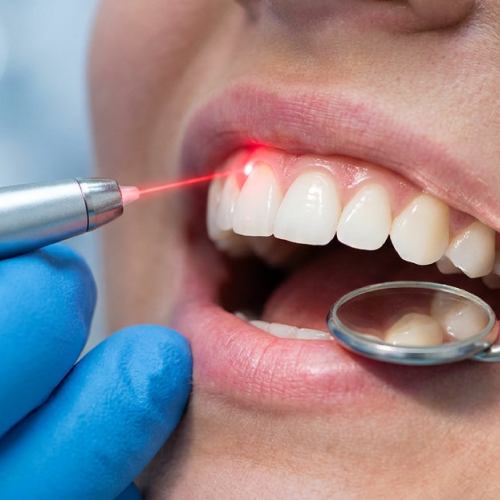
Is Gum Contouring Permanent? What Actually Determines How Long Results Last
Discover if gum contouring is permanent and what factors influence your long-term results. Learn if gums can grow back and book your consultation in Riverside!
Read More
The "best" option isn't about aesthetics alone — your bite force, the origin of your staining, and how much enamel you have left are the real clinical decision-makers. This guide breaks down exactly how I evaluate these factors for patients in Riverside and the Inland Empire, where our aesthetic dentistry approach starts with your biology, not a treatment menu.
This is the part most patients don't hear until after something breaks. For Riverside-area patients, we often find that bite mechanics dictate the treatment. You come in wanting veneers — conservative, minimal prep, beautiful result — and that's a completely reasonable goal. But if you grind your teeth at night, clench under stress, or have visible wear on your existing enamel, veneers may fail within months regardless of the material or the lab that made them.
Bruxism creates lateral forces that porcelain wasn't designed to absorb repeatedly. A veneer bonds to the front surface of your tooth, covering roughly 1mm of thickness. That geometry works beautifully under normal biting loads. Under grinding forces, that same geometry becomes a liability.
When I evaluate patients for cosmetic work, I look at several factors before recommending veneers:
If these signs are present, a full tooth crown becomes the mechanically superior option — not because it looks better, but because it wraps 360 degrees around the tooth. That full coverage creates what clinicians call the "ferrule effect," distributing bite forces evenly rather than concentrating them at a veneer's bond line. According to Cleveland Clinic, crowns can withstand heavy biting and chewing forces in ways that other restorations cannot.
This doesn't mean veneers are fragile for the average patient. It means the right restoration depends on your specific oral mechanics, not just what you've seen on social media.
Whitening is the most conservative intervention I offer, and when it works, it's remarkable. But it has a hard chemical ceiling — and understanding that ceiling saves patients significant time and money.
Here's the distinction that matters most: extrinsic stains live on the surface and in the outer enamel pores. Coffee, tea, red wine, tobacco — these respond well to peroxide-based whitening because the bleaching agent can reach and oxidize the chromogen molecules causing discoloration. As Cleveland Clinic explains, professional whitening works best on these surface stains. For patients who are good candidates, pro teeth whitening can deliver remarkable results in a single visit.
Intrinsic stains are a different problem entirely. These originate inside the dentin — the layer beneath enamel — and develop from:
Whitening agents work by penetrating the enamel and oxidizing organic compounds. They cannot chemically alter dentin that was structurally changed during formation. Tetracycline molecules, for example, bind directly to the calcium in developing dentin. No concentration of hydrogen peroxide reverses that.
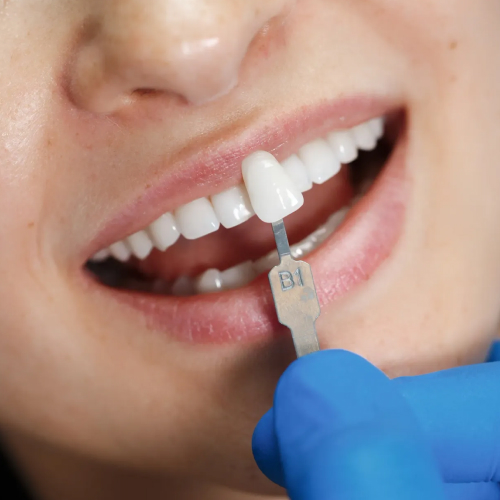
So what does work? For mild intrinsic staining, porcelain veneers can be highly effective — but with an important caveat. Standard translucent porcelain veneers transmit light. If the underlying tooth is dark gray or heavily tetracycline-banded, that darkness can show through the veneer and produce a result that still looks "off." In these cases, I discuss high-opacity porcelain systems or, for severely affected teeth, crowns — which provide the full coverage needed to completely mask the underlying color. Research published in PMC confirms that porcelain veneers offer a conservative and effective option for discolored anterior teeth, while noting that severe cases may require additional consideration of the underlying substrate color.
If your staining is intrinsic, whitening is unlikely to produce the result you're hoping for. That's not a failure of the treatment — it's simply the wrong tool for the problem.
Every cosmetic decision in dentistry involves a biological trade-off. I want my patients to understand this before we proceed, because some choices are irreversible.
Here's how the numbers break down in terms of enamel removal:
That difference isn't just millimeters. It's the difference between a tooth that could theoretically return to its natural state and one that cannot. A Healthline overview of veneers notes that traditional veneer preparation is considered irreversible because the enamel removal permanently alters the tooth surface.
Once you move from a veneer to a crown, you can never go back to a veneer. The enamel that created the bonding surface is gone. This is what I call the "point of no return" — and it's why I advocate strongly for the most conservative option that still achieves the clinical goal.
The good news is that veneers placed correctly on healthy teeth show impressive longevity. WebMD notes that both veneers and crowns serve distinct purposes and that matching the restoration to the clinical need is what drives long-term success. Mouthhealthy.org also emphasizes that licensed dentists must evaluate each case individually before placing any veneer.
My approach: start with the least invasive option that genuinely solves the problem. Whiten first if the staining is extrinsic. Consider veneers if the teeth are structurally sound and the bite is compatible. Reserve crowns for teeth that need structural protection, have significant decay requiring cavity fillings or more extensive restoration, or face mechanical forces that veneers cannot handle.
No blog post replaces a clinical exam — and I mean that genuinely, not as a disclaimer. The same symptom (dark teeth) can require three completely different treatments depending on whether the discoloration is extrinsic, intrinsic, or structural. The same goal (a brighter smile) might be achievable with whitening for one patient and require veneers or crowns for another.
What I can tell you is the framework I use: evaluate the stain origin, assess the bite mechanics, calculate the enamel cost, and then recommend the most conservative option that will actually hold up long-term. Open communication about your goals — and honest feedback about your biology — is the only way to get a result you'll still love in ten years. That process always begins with a thorough cleaning and exam so we have a complete picture of your oral health before recommending any cosmetic path forward.
If you're weighing veneers, crowns, or whitening and want a clinical opinion grounded in your actual oral health — not a sales pitch — I'd welcome the conversation. At Dental Specialists of Riverside, we serve patients throughout Riverside and the broader Inland Empire with exactly this kind of individualized treatment planning. Schedule a consultation and let's figure out what your teeth actually need.
Medical disclaimer: This article is intended for general informational purposes only and does not constitute professional dental or medical advice. Always consult a licensed dental professional for diagnosis and treatment recommendations specific to your situation.
Fresh news from the dental world


Mon, Tues, Thur 9AM - 6PM
Weds 10AM - 7PM
Friday 8AM - 5PM
Sat & Sun Closed
Check out what our patients are saying in Riverside...
..png)

“Never Disappointed...”
“I don’t have much time to waste, so I always get my whitening done by the good folks at Dental Specialists of Riverside. Never disappointed.”

“So Comfortable...”
"I have been coming here for years and I love this place. I feel so comfortable whenever I go into ortho. Everyone's really friendly! The ladies at the front desk are my favorite, they're always so helpful and always try their best to work around my schedule. Would definitely recommend!"

“Expert Care...”
“I have come a long way with all my dental issues. I’ve been able to take back control of my dental health because of the expert care I’ve received over the years at Dental Specialists of Riverside. I highly recommend this place because they won’t pressure you into stuff that you don’t need or that you are not ready for.”

“What a Difference...”
“My wife and I recently decided to try teeth whitening here. Wow! What a difference. Thank you!”
“Never Disappointed...”
“I don’t have much time to waste, so I always get my whitening done by the good folks at Dental Specialists of Riverside. Never disappointed.”
“So Comfortable...”
"I have been coming here for years and I love this place. I feel so comfortable whenever I go into ortho. Everyone's really friendly! The ladies at the front desk are my favorite, they're always so helpful and always try their best to work around my schedule. Would definitely recommend!"
Check out our accreditations, sources, and relationships in the wide world of dentistry...
..png)
..png)
..png)
Check us out and follow our Riverside, CA practice on social media...


..png)