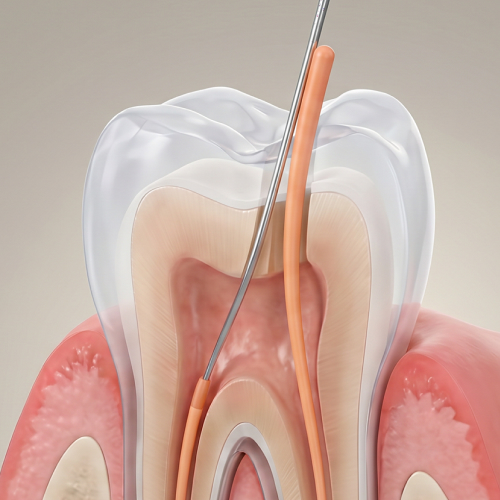
Pulp Capping vs. Root Canal: What Riverside Patients Should Know Before Choosing
Wondering if you need a root canal or pulp capping? Learn the differences and save your tooth. Contact Dental Specialists of Riverside to book your visit!
Read More
Whitening and veneers solve different problems — and mixing them up in the wrong order can cost you thousands. Before committing to either, understanding how these treatments interact with existing or planned restorations is essential for Riverside and Inland Empire patients. Whether you're considering professional teeth whitening or a more comprehensive cosmetic solution, the sequence of treatment is critical.
Most patients ask whether to whiten or get veneers. The more important question is when to do each — because the sequence is permanent.
According to WebMD, bleaching agents cannot change the color of porcelain crowns or tooth-colored composite bonding. Porcelain is color-stable by design. Your natural enamel is not. This creates a "shade-lock" problem that catches patients off guard.
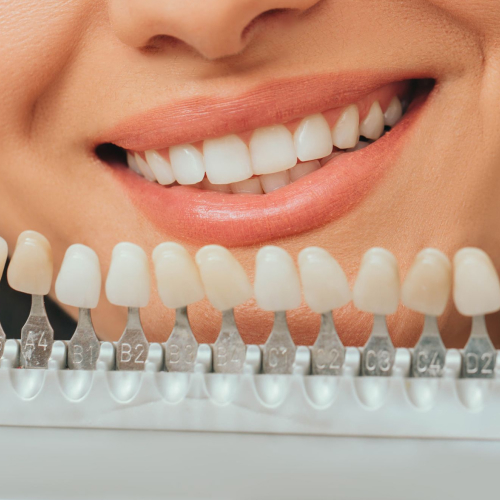
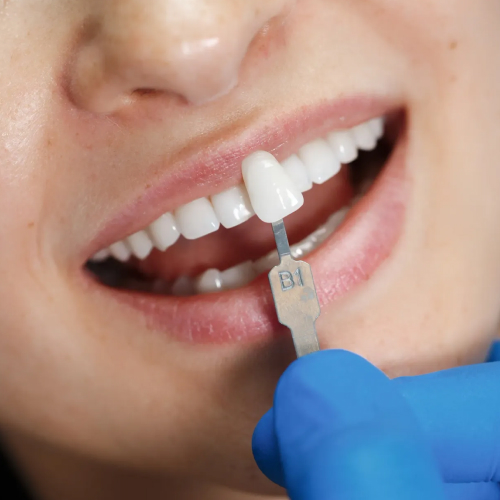
Here's how it happens: you whiten your teeth to a bright B1 shade, then get a veneer or crown custom-matched to that color. The porcelain is now permanently locked to your whitened shade. If your maintenance slips — fewer touch-up treatments, more coffee, normal aging — your natural teeth gradually yellow back. The crown or veneer doesn't follow. Over time, your restoration looks artificially bright against duller surrounding teeth.
The solution is choosing a realistic maintenance shade before any restoration work begins. Whiten to a level you can sustain for decades, not the brightest possible result.
There's also a bonding timing issue. Research published in PMC shows that bleaching leaves residual oxygen in enamel that reduces composite bond strength by 25–60% when bonding is done immediately after treatment. A waiting period of at least 14 days after whitening is recommended before color-matching or bonding new veneers or chip repairs. Skipping this step risks weaker adhesion and color mismatch — both expensive problems to fix.
If veneers or crowns are anywhere in your near-future treatment plan, discuss the full sequence with your dentist before whitening. The order matters more than either treatment alone.
This is one of the most common misconceptions in cosmetic dentistry — and the answer is more nuanced than a simple no.
Whitening doesn't repair chips or close gaps structurally. But it can actually make them more noticeable, which is something most articles never mention. As whitening agents increase the brightness and opacity of surrounding enamel, they create higher visual contrast around structural flaws.
At the incisal edge — the biting edge of your front teeth — enamel is naturally thin and slightly translucent. A chip makes it thinner still, or removes it entirely. When the thick surrounding enamel is whitened to a brighter shade, that jagged, translucent chip edge appears comparatively darker and greyer. The gap between teeth works similarly: a diastema framed by brilliant white enamel draws the eye more sharply to the dark space between.
Healthline's overview of dental veneers explains that porcelain veneers are specifically designed for situations like these — chipped teeth, smaller-than-average teeth, and gaps — because they cover the structural issue rather than working around it.
For chips, composite edge bonding is often the most conservative next step after whitening. A small amount of tooth-colored resin is sculpted onto the chipped edge, closing the light-leak and blending with the newly brightened surrounding enamel. For gaps, veneers or orthodontic treatment address the root geometry that whitening cannot touch.
The practical takeaway: if chips or gaps bother you, whiten first (with the 14-day bonding wait in mind), then address the structural issue. Reversing the order means your repair material may not match your final whitened shade.
The standard answer — "whitening doesn't work on porcelain" — is technically correct but leaves out something useful.
The ADA's oral health resource on whitening confirms that bleaching agents work through oxidation of organic chromogens in natural tooth structure. Porcelain and ceramic contain no such chromogens, so peroxide has nothing to react with.
But what many patients are actually seeing isn't the porcelain itself staining — it's margin staining. The margin is the thin line where the restoration meets the natural tooth or gumline. Over time, cement can micro-degrade at this junction, and dietary pigments or bacteria accumulate in the gap. The result looks like a stained tooth crown, but the discoloration is at the interface, not inside the material.
Surface-level staining on porcelain — from coffee, tea, or tobacco pellicle — is also different from true material discoloration. Harvard Health's guidance on tooth whitening notes that professional prophylaxis can remove surface deposits that home kits simply cannot reach. Air-powder polishing (Prophy-Jet) or professional micro-abrasion at the dentist's office can often dramatically brighten a crown's appearance by stripping away years of surface accumulation — without any bleaching chemistry at all.
If your crown looks dull or "stained," a quick checklist helps identify the real issue:
Knowing which category applies gives you a concrete action plan rather than a dead-end answer.
Neither is universally better. They solve different problems at different price points and commitment levels.
Whitening is the right starting point for patients with healthy tooth structure whose main concern is color. It's non-invasive, reversible in the sense that it doesn't alter tooth structure, and significantly less expensive than restorations. Mouthhealthy.org from the ADA recommends speaking with your dentist before any whitening treatment to confirm candidacy and set realistic expectations. Routine cleaning and exam appointments are also a good opportunity to discuss your cosmetic goals before committing to any treatment.
Veneers are appropriate when the problem is structural — chips, worn edges, gaps, severe intrinsic staining from tetracycline or fluorosis, or significant shape irregularities. They provide a more permanent cosmetic correction, but they require enamel removal and represent a long-term restorative commitment.
For many Riverside and Inland Empire patients, the answer is actually both — whitening first, followed by targeted restorative work — executed in the right sequence, with proper timing between steps. In some cases, aesthetic dentistry solutions can be combined to address both color and structural concerns in a single comprehensive treatment plan.
If you're weighing whitening, veneers, or both, a personalized evaluation makes all the difference. Dental Specialists of Riverside serves patients throughout Riverside and the Inland Empire with comprehensive cosmetic dentistry planning — including treatment sequencing that protects your investment. Contact us to schedule a consultation.
This article is for informational purposes only and does not constitute dental or medical advice. Individual results vary. Consult a licensed dental professional to determine which treatments are appropriate for your specific situation.
Fresh news from the dental world


Mon, Tues, Thur 9AM - 6PM
Weds 10AM - 7PM
Friday 8AM - 5PM
Sat & Sun Closed
Check out what our patients are saying in Riverside...


“What a Difference...”
“My wife and I recently decided to try teeth whitening here. Wow! What a difference. Thank you!”

“So Comfortable...”
"I have been coming here for years and I love this place. I feel so comfortable whenever I go into ortho. Everyone's really friendly! The ladies at the front desk are my favorite, they're always so helpful and always try their best to work around my schedule. Would definitely recommend!"

“Expert Care...”
“I have come a long way with all my dental issues. I’ve been able to take back control of my dental health because of the expert care I’ve received over the years at Dental Specialists of Riverside. I highly recommend this place because they won’t pressure you into stuff that you don’t need or that you are not ready for.”
..png)
“Never Disappointed...”
“I don’t have much time to waste, so I always get my whitening done by the good folks at Dental Specialists of Riverside. Never disappointed.”
“What a Difference...”
“My wife and I recently decided to try teeth whitening here. Wow! What a difference. Thank you!”
“So Comfortable...”
"I have been coming here for years and I love this place. I feel so comfortable whenever I go into ortho. Everyone's really friendly! The ladies at the front desk are my favorite, they're always so helpful and always try their best to work around my schedule. Would definitely recommend!"
Check out our accreditations, sources, and relationships in the wide world of dentistry...
..png)
..png)
..png)
Check us out and follow our Riverside, CA practice on social media...

..png)
