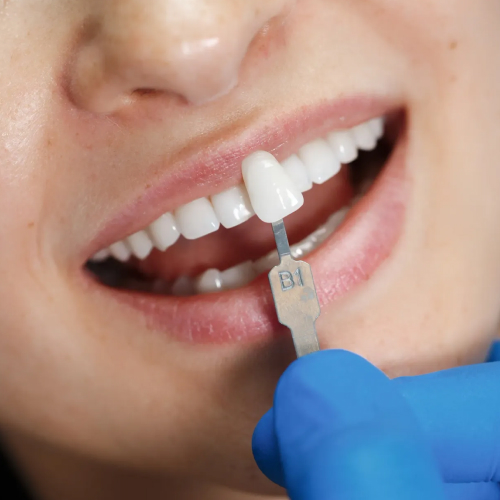
How Many Visits Do Veneers Really Take — And What Happens at Each One?
How many visits are needed for veneers? Explore our step-by-step guide to custom veneers and see how we create your perfect smile. Contact us to get started!
Read More
One of the most common things I hear from parents is some version of: "But the pediatric dentist said everything looks fine." I understand why that's reassuring — and in many ways, it should be. For Riverside-area patients, pediatric dentists do outstanding work catching cavities, monitoring eruption timelines, and keeping young teeth healthy. But there's a real diagnostic gap between what a cleaning and exam visit reveals and what an orthodontic consultation uncovers.
Here's the core difference: a pediatric dentist typically uses bitewing X-rays to detect decay between teeth. An orthodontist uses a cephalometric X-ray — a lateral skull film that maps the geometric relationship between your child's jaw, skull base, and teeth. This is an entirely different category of information. A ceph X-ray can reveal a narrow palate, a recessed lower jaw, or a skeletal discrepancy that causes zero visible symptoms in childhood but becomes a complex (and expensive) problem to correct in adulthood.
During a full orthodontic consultation at my practice, we also use digital scanning technology to capture the three-dimensional relationship of the teeth and bite. A child can have perfectly cavity-free teeth and still have a jaw that's developing off-track. As Cleveland Clinic explains, orthodontics specifically addresses "bad bites" — and the way your upper and lower teeth meet has a significant impact on long-term oral health, including your risk for cavities and gum disease down the road.
So when parents ask whether their child's pediatric dental visits cover early orthodontic assessment, the honest answer is: partially. General and pediatric dentists can flag obvious concerns, but they're not equipped with the same diagnostic tools — or the same specialized training — that an orthodontist brings to the table. According to WebMD, orthodontists complete two to three years of residency training beyond dental school, focused entirely on tooth movement and jaw development.
The recommendation to bring your child in by age 7 comes from the American Association of Orthodontists, and it's grounded in developmental biology, not marketing. By age 7, most children have a mix of baby and permanent teeth — enough for an orthodontist to evaluate how the bite is forming, how the jaw is growing, and whether any intervention is warranted.
Mayo Clinic notes that this early exam "provides a baseline assessment of a child's teeth and jaws and can help catch problems in their early stages." Conditions like crossbites, protruding upper teeth, crowding, and jaw asymmetry can all be identified at this stage.
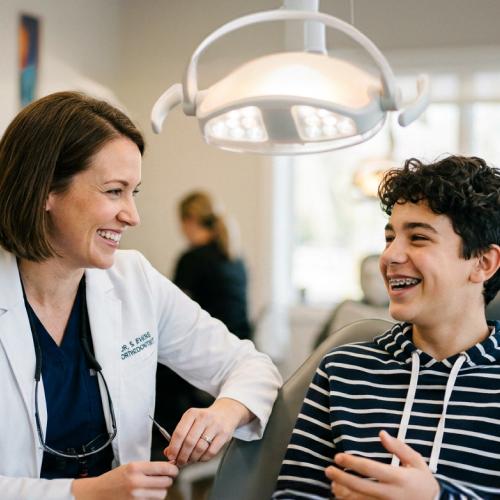
But here's what most parents don't expect: the most common outcome of an age-7 orthodontic consultation is not braces. It's enrollment in what I think of as a Growth and Guidance Program — essentially an observation schedule where we monitor your child every 6 to 12 months at no additional cost. We're watching for specific developmental milestones: how the 12-year molars are erupting, whether the upper canines are tracking correctly, how the palate is widening, and whether any early skeletal patterns are self-correcting or worsening.
This "Observation Club," as some families come to call it, is genuinely valuable. The goal isn't to start treatment prematurely — it's to identify the precise window when treatment will be most efficient and least complex. Research published in PMC confirms that the mixed dentition stage (ages 7–11) represents a critical period where targeted interceptive treatment can meaningfully reduce the need for more complex correction later. However, that same research makes clear that treatment timing must be individualized — not every child benefits from early intervention.
Our children's dentistry approach is built around exactly this kind of long-term, individualized monitoring — so families aren't rushed into treatment before the timing is right.
For children who do need early intervention — typically expanders, partial braces, or functional appliances — parents often worry they're signing up to pay for orthodontic treatment twice. It's a legitimate concern, and one I make a point of addressing directly during every consultation.
Most orthodontic offices, including mine, operate on a Phase 1 to Phase 2 credit model. The fees paid for early interceptive treatment (Phase 1) are partially credited toward the cost of comprehensive teeth straightening braces or aligners (Phase 2) when your child is older. This means you're not being double-billed for the same correction — you're paying for two distinct phases of treatment, with built-in financial overlap.
Before committing to Phase 1 treatment at any office, I'd encourage parents to ask these questions directly:
Getting clear answers to these questions protects families from financial surprises. Healthline notes that early diagnosis and treatment tends to reduce the severity of problems over time — which often translates directly to shorter, less intensive (and less expensive) Phase 2 treatment.
Malocclusion is the third most common dental condition after cavities and gum disease, and its effects go well beyond aesthetics. Research from the AAPD reinforces that early oral health care — including orthodontic assessment — is essential health care, not a cosmetic luxury.
If you're in the Riverside or Inland Empire area and wondering whether it's time to bring your child in for their first orthodontic evaluation, I'd encourage you to schedule a consultation sooner rather than later. At Dental Specialists of Riverside, we use cephalometric imaging and digital scanning to give you a complete picture of your child's jaw and bite development — not just their teeth. Whether your child is 7 or 17, we'll give you an honest assessment, a clear treatment timeline, and straightforward answers on costs and options. We also offer Invisalign as part of our comprehensive orthodontic solutions for patients of all ages. Reach out to our Riverside office to get started.
This article is intended for general informational purposes only and does not constitute professional dental or medical advice. Always consult a licensed dental professional for diagnosis and treatment recommendations specific to your situation.
Fresh news from the dental world



Mon, Tues, Thur 9AM - 6PM
Weds 10AM - 7PM
Friday 8AM - 5PM
Sat & Sun Closed
Check out what our patients are saying in Riverside...
..png)

“Never Disappointed...”
“I don’t have much time to waste, so I always get my whitening done by the good folks at Dental Specialists of Riverside. Never disappointed.”

“So Comfortable...”
"I have been coming here for years and I love this place. I feel so comfortable whenever I go into ortho. Everyone's really friendly! The ladies at the front desk are my favorite, they're always so helpful and always try their best to work around my schedule. Would definitely recommend!"

“Expert Care...”
“I have come a long way with all my dental issues. I’ve been able to take back control of my dental health because of the expert care I’ve received over the years at Dental Specialists of Riverside. I highly recommend this place because they won’t pressure you into stuff that you don’t need or that you are not ready for.”

“What a Difference...”
“My wife and I recently decided to try teeth whitening here. Wow! What a difference. Thank you!”
“Never Disappointed...”
“I don’t have much time to waste, so I always get my whitening done by the good folks at Dental Specialists of Riverside. Never disappointed.”
“So Comfortable...”
"I have been coming here for years and I love this place. I feel so comfortable whenever I go into ortho. Everyone's really friendly! The ladies at the front desk are my favorite, they're always so helpful and always try their best to work around my schedule. Would definitely recommend!"
Check out our accreditations, sources, and relationships in the wide world of dentistry...
..png)
..png)
..png)
Check us out and follow our Riverside, CA practice on social media...


..png)